
A histamine flare hits without warning. The sequence of events that leads up to histamine overload symptoms usually goes like this. One minute you feel fine. You’re enjoying your life, breathing easily and in control of your life.
But then, wham! Suddenly your face flushes, your head pounds, your gut seizes, or your skin itches like crazy. So intense is the itching that you’re trying to scratch various parts of your body all at once.
Your body dumps histamine faster than your diamine oxidase (DAO) enzyme can break it down. The result? A cascade that feeds on itself if you try to ignore it.
You may not be able to stop a histamine flare in minutes but you can do certain things to help bring them under control over minutes to hours.
The goal is to clear as much circulating histamine as you can, stabilize mast cells, support breakdown pathways, calm your out-of-control nervous system, and stop new histamine from forming.
Each one rests on real mechanisms and published research. Use them together for the strongest effect.
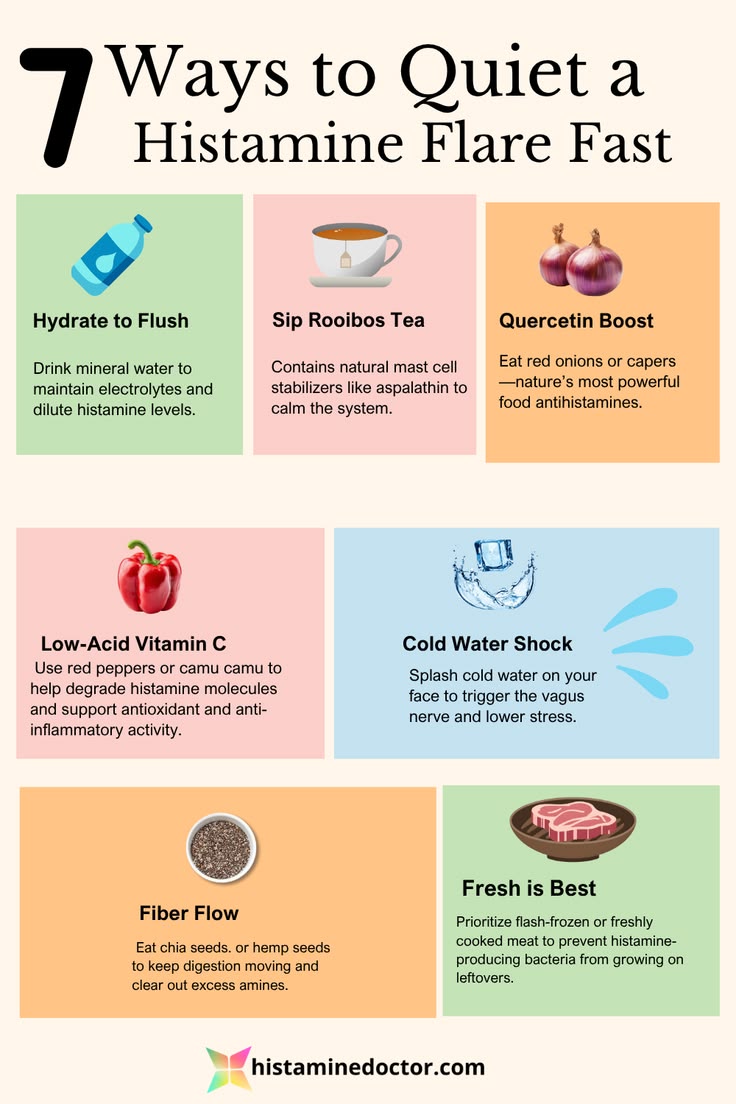
1. Hydrate to Flush
Here’s the truth. Most of us don’t drink enough water, and if you have histamine intolerance, you need to be aware of this and compensate.
Histamine dissolves in water. When you raise your fluid intake, your kidneys clear more histamine from your bloodstream and you eliminate it faster.
Dehydration does the opposite. It concentrates histamine and slows how quickly your body gets rid of histamine build-up. Plus, dehydration is harmful in other ways, that we won’t go into here.
Suffice it to say, it makes you feel tired, worsens headaches, and can even harm your kidneys and blood vessels if it’s severe.
I have had patients tell me that once they started carrying around a stainless steel water bottle and sipping on it, they felt better in general. Your body is more than 60% water, so it’s not surprising.
Plain water? Nope, reach for mineral water. The electrolytes—especially magnesium and potassium—support the enzymes that degrade histamine and keep cellular pumps working.
Drink steadily rather than chugging a huge amount at once. Aim for an extra 16–24 ounces in the first hour of a flare, then maintain normal intake.
Plain sparkling mineral water works if still water feels flat. Avoid flavored versions that hide citrus or additives.
This step costs almost nothing and starts working within minutes. The more you sip, the more your plasma volume increases, the faster you clear histamine, and the better you feel.
2. Sip Rooibos Tea
Have you tried rooibos tea? It’s an herbal tea that contains aspalathin, a flavonoid that stabilizes mast cells.
A 2024 study in Inflammation showed aspalathin blocks the FcεRI signaling pathway, a pathway that triggers mast cells to release histamine and other inflammatory mediators.
In both cell models and mouse allergy models, aspalathin cut histamine release. It also reduced swelling and systemic reactions. It also outperformed another major rooibos compound, nothofagin.
Action plan:
Brew a strong cup with hot (not boiling) water and sip it slowly. Green (unfermented) rooibos holds higher aspalathin levels, but the red version still helps.
Rooibos sits low on histamine lists and contains none of the caffeine that can further stress mast cells. Keep a thermos ready so the next cup stands ready when symptoms start.
3. Quercetin Boost
Quercetin is a type of bioflavonoid. It’s also a natural mast-cell stabilizer. Plus, studies show it has natural anti-histamine activity – and you know what that means!
Although it’s an area that needs more research, early research shows modest benefits for health as a whole.
A randomized trial of a quercetin-containing supplement (200 mg daily) improved eye and nose allergy symptoms and quality-of-life scores over a 4 week period. Other studies show consuming quercetin helped subdue histamine-induced skin reactions.
So where do you get it? Capers rank among the richest food sources (over 170 mg per 100 g). Red onions follow close behind.
Chop a small red onion into a salad or add a tablespoon of rinsed capers to a meal. If onions bother your gut during a flare, start with the capers alone.
You’ll get the most benefits if you consume quercetin regularly, but even a single dose can have modest benefits.
4. Low-Acid Vitamin C
Vitamin C (ascorbic acid) is an antioxidant vitamin, but it also helps break down histamine. Older research by Clemetson found an inverse relationship: lower ascorbic acid was linked with higher histamine. High-dose vitamin C (oral or IV) has lowered blood histamine by 38–50% in some reports.
You probably think of citrus when you think of vitamin C, but get your vitamin C from low histamine options. Red bell peppers deliver a solid, low-acid dose of vitamin C without the citric acid load of oranges or lemons.
Camu camu powder packs even more. A 2022 study on camu-camu extract showed it reduced histamine release from mast cells. It also blocked H1 and H4 receptors, and lowered histidine decarboxylase activity, the enzyme that makes histamine in the first place.
Eat half a raw red pepper or stir a quarter teaspoon of camu camu into water or a tolerated smoothie. The antioxidant and anti-inflammatory actions also quiet the secondary inflammation that keeps a flare going.
5. Cold Water Shock
Stress itself triggers mast cells. Cold water on the face interrupts that loop. The mammalian dive reflex fires when cold hits the forehead, eyes, and cheeks.
Trigeminal nerve signals reach the brainstem and activate the vagus nerve. Heart rate drops, sympathetic drive falls, and parasympathetic tone rises within seconds.
No need for a full plunge. Fill a bowl with cold water or ice water and splash it on your face for 15–30 seconds. Repeat two or three times.
Many people notice a rapid drop in the “wired and itchy” feeling that you feel during a histamine surge. The same reflex underlies the cold-face technique used in dialectical behavior therapy for acute distress.
6. Fiber Flow
How’s your fiber intake? Studies show Americans get only half the amount of fiber they should get for gut health and general health. The lack of fiber could also impact histamine intolerance symptoms.
Histamine and other biogenic amines leave the body partly through the gut. Slow transit lets bacteria convert more histidine into histamine and lets existing amines reabsorb.
Fortunately, there are healthy fiber options that shouldn’t boost your histamine load.
Chia and hemp both appear on many low-histamine lists when fresh. Soak a tablespoon of chia in water for ten minutes until it gels, or sprinkle hemp hearts over food.
The fiber also binds some residual amines and keeps the digestive tract moving so excess histamine does not linger.
Start with a more modest amount if your gut feels sensitive and increase the amount as your gut adapts to a higher fiber diet.
7. Fresh Is Best
Always think fresh when it comes to recovering from a histamine flare. Bacteria on meat and fish convert free histidine into histamine when food sits around, even if you store it in the refrigerator.
I know you don’t want to toss edible food, especially with food costs being so high, but it’s not worth your histamine intolerance acting up. Once histamine forms, cooking won’t destroy it.
And once you put it in the refrigerator, the clock is ticking. Leftovers that sit in your fridge for even a day will start accumulating histamine.
With histamine intolerance, freezing is your best friend. Choose flash-frozen fish or meat and cook it the same day you thaw it. If you cook extra, portion it while still hot and freeze it immediately.
Reheat from frozen rather than reheating what you pull out of the refrigerator. Studies that have tracked biogenic amines in meat from the fridge show sharp rises in putrescine, cadaverine, and sometimes histamine even when you set your refrigerator at a low temperature.
So, cook fresh, freeze extras, and thaw/reheat only what you plan on eating.
Histamine Intolerance Self-Care
These tactics do not replace medical care but they still give you a way to get a leg up on histamine intolerance symptoms. Track which ones help you most. Your response will tell you where to double down.
Small, repeated experiments build the toolkit that keeps histamine from running the show.
References:
Clemetson, C. A. B. (1980). Histamine and Ascorbic Acid in Human Blood. The Journal of Nutrition, 110(4), 662–668. https://doi.org/10.1093/jn/110.4.662
Do, N. Q., Zheng, S., Oh, S., Nguyen, Q. T. N., Fang, M., Kim, M., Choi, J., Kim, M.-J., Jeong, J., & Yi, T.-H. (2021). Anti-Allergic Effects of Myrciaria dubia (Camu-Camu) Fruit Extract by Inhibiting Histamine H1 and H4 Receptors and Histidine Decarboxylase in RBL-2H3 Cells. Antioxidants, 11(1), 104. https://doi.org/10.3390/antiox11010104
Kim, Y., Lee, S., Jin, M., Choi, Y.-A., Choi, J. K., Kwon, T. K., Khang, D., & Kim, S.-H. (2024). Aspalathin, a Primary Rooibos Flavonoid, Alleviates Mast Cell-Mediated Allergic Inflammation by the Inhibition of FcεRI Signaling Pathway. Inflammation, 48(1), 199–211. https://doi.org/10.1007/s10753-024-02034-1
Jafarinia, M., Sadat Hosseini, M., Kasiri, N., Fazel, N., Fathi, F., Ganjalikhani Hakemi, M., & Eskandari, N. (2020). Quercetin with the potential effect on allergic diseases. Allergy, Asthma & Clinical Immunology, 16, 36. https://doi.org/10.1186/s13223-020-00434-0
Kristie Leong M.D. M.S.

Hi! I'm Dr. Kristie Leong M.D. M.S. I graduated from Virginia Commonwealth University and have a deep interest and passion for histamine intolerance. My journey includes a comprehensive Kindle ebook on Histamine Intolerance and its dietary management.With a Masters in Clinical Pathology, my knowledge of immunology adds a robust scientific foundation to my expertise. I wholeheartedly believe in the power of lifestyle and prevention in healthcare. Let's work together to manage histamine intolerance through practical dietary and lifestyle choices. :-)